
March 10th, 2026 |
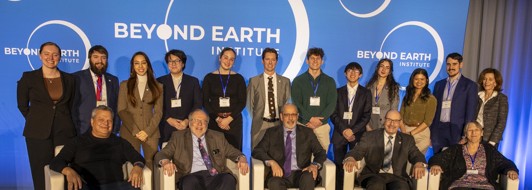
No summary can fully capture the energy of the 2026 Beyond Earth Symposium, held at Grossman Hall at American University Washington College of Law. But here are the moments that mattered most.
BE Advisor Bhavya Lal set a compelling tone in the opening session: the real prize isn’t being the first astronauts to land on the Moon before China—it’s building a sustained presence there. And those who establish the infrastructure – e.g., PNT, power networks – help ensure overall leadership. Think of the benefits that accrued to the U.S. when it allowed free use of the Global Positioning System as a global navigation utility.
Moderated by Space News’ Jeff Foust, a panel featuring former NASA Deputy Administrator Lori Garver, Thomas Zurbuchen, Greg Autry, and Peter Garretson wrestled with the strategic choices ahead. The consensus: flags-and-footprints moments are fleeting; lasting leadership is built over decades.
Dave Cavossa, President of the Commercial Space Federation, delivered a pointed update on the CSF’s Red Shift report—a comprehensive assessment of China’s accelerating space program. His message was blunt: China is not going to stop, whether the U.S. gets to the Moon first or not. The stakes extend well beyond prestige to industrial competitiveness and national security.
John Reed of United Launch Alliance led a vivid discussion on sustaining lunar life—keeping inhabitants alive in a radiation-soaked vacuum. Jim Keravala of OffWorld expanded the vision to large underground communities shielded beneath the surface. Daniel Inocente offered a sharp comparative analysis of SpaceX’s Starship versus Blue Origin’s Blue Moon, concluding that both systems will be needed to develop a scalable lunar base.
The session’s most energizing moment came from young entrepreneur Skyler Chan of GRU Space, who shared his vision for a hotel on the Moon. The company’s first revenue stream? Turning lunar regolith into bricks (samples were displayed at the Symposium)—the literal building blocks of his lunar hotel, and potentially for anyone else developing on the surface.
Congressional staffer Brent Blevins offered an insider view on the NASA Authorization bill recently reported out of committee, with hopes for Senate action and a commercial space bill to follow. A veteran policy panel—including Scott Pace, Charles Miller, Kevin O’Connell, and Courtney Stadd—debated the governance frameworks required to turn orbital outposts into thriving communities. Stadd declared his “faith” in a long-term space migration future; Pace was more agnostic, calling it one of several possible paths.
On the question of governing growing space stations, Jim Muncy floated the idea of a port authority–style entity for lunar development. FAA’s Kelvin Coleman offered perhaps the day’s most memorable line: space travel should eventually feel as routine as a trip to the DMV—which, he noted, “doesn’t come to our house and inspect our car before every trip we take.”
The symposium’s most moving conversation was the fireside chat with Martine Rothblatt—founder of both Sirius XM and United Therapeutics. Amid a wide-ranging discussion on space and digital consciousness, she recounted how she built her pharmaceutical company with one explicit goal: to cure her daughter’s incurable disease. She succeeded. The company thrived. It was a powerful reminder that the most ambitious visions are often driven by deeply personal stakes.
Former NASA Chief Scientist Jim Green explored a credible path to terraforming Mars and making the red planet hospitable for human civilization. The final panel brought things back to earth: while capital for space ventures is more available than ever, investors are becoming more selective and want earlier returns—a tension that will define the next phase of the industry.
Beyond Earth also presented its Space Settler Award to the Honorable Robert S. Walker, recognizing his decades of tireless, bipartisan service to commercial space development in Congress and beyond.