
August 7th, 2026 |
By Steve Wolfe, President, Beyond Earth Institute
I've spent much of my career working on space policy from behind a desk — writing legislation, building coalitions, advocating for the industry I love. It's meaningful work, but it's also, by nature, a step removed from the thing itself. Nothing quite prepared me for what it felt like to actually live a simulated mission to the Moon. That's exactly what I got to do recently at Space Nation's Moon Pioneers training experience in Midland, Texas, and I'm still processing just how much it moved me — and how strongly I now believe every person working in or around the space sector should experience it for themselves.
Day One: Building the Team
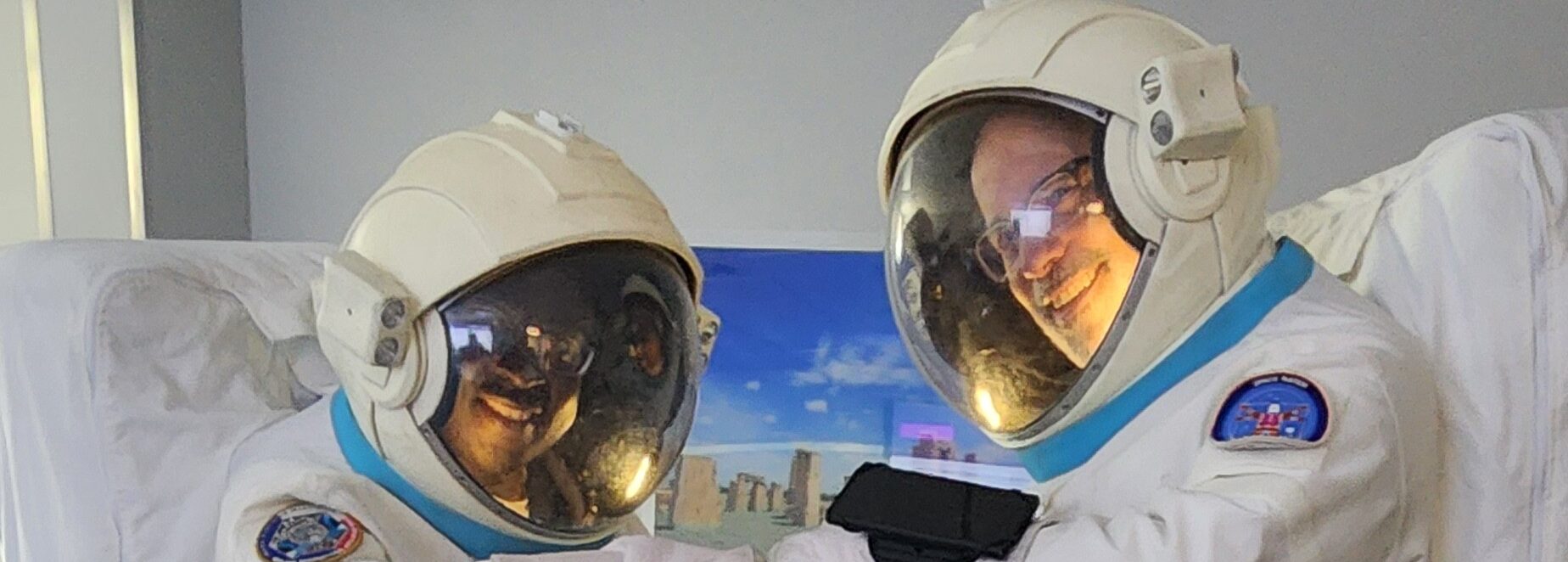
The mission opened with Space Nation founder Kalle Vähä-Jaakkola setting the stage — a discussion that gave real context to where humanity is headed in space and why programs like this matter right now, at this moment in the industry's growth. From there, we moved quickly into hands-on training led by Alex Arthur, a special forces veteran who served two tours in Afghanistan. Alex has a gift for making team-building exercises feel both fun and genuinely demanding, and every drill turned out to be essential preparation for the simulated mission ahead. Getting fitted for our EVA spacesuits that first day was, I'll admit, a personal highlight — it's hard not to feel a little bit like an astronaut once you're zipped into one.
What struck me most on Day One, though, was my cohort. We came from wildly different backgrounds — Michael, a genetic biology student with his eye on the astronaut corps; Marcus, a former Air Force officer eyeing a move into the space industry; Tony, a retired engineer who'd always dreamed of spaceflight; Gabby, a health professional passionate about space; and Alexis, a project manager looking to grow her skill set — and yet within hours we'd formed a real bond. That's one of the things I didn't fully anticipate going in: the people. You don't just train alongside your cohort, you rely on them, problem-solve with them, and end up genuinely rooting for them. That evening we had dinner with two-time astronaut Terry Virts, who would be guiding us through the mission the next day.
Day Two: When Things Got Real
If Day One was preparation, Day Two was the mission. With Terry Virts and the Space Nation team guiding us, my crew was assigned roles and dropped into a full moon base scenario. Space Nation's instructors monitored us closely but refused to hold our hands — we were challenged to the limits of our knowledge, creativity, and ability to work as a team under pressure. There were moments of real stress mixed in with genuine fun, and by the time the simulation ended, the sense of accomplishment in the room was tangible. At the debrief, Terry, Kalle, and Alex walked us through our performance in detail, and I'm proud to say our crew earned high marks. We closed out the day with a meal at the Blakemore Planetarium, which felt like the perfect way to end a day spent training for the Moon — good food, good company, and a ceiling full of stars to remind us why we were there in the first place.
Day three brought new challenges to a new, exciting location. To save some surprises for those who attend the program, I will just say that it was a great way to wrap up our exciting experience.
Why This Kind of Experience Is Different
I've sat through plenty of conferences, panels, and briefings over the years. They're valuable, but they tend to inform rather than transform. The Space Nation experience is different because it's built on doing, not just listening. You're not taking notes about leadership under pressure — you're living it, in real time, with real consequences within the simulation and real people counting on you. That distinction matters more than I expected.
It also matters because of who's leading it. Training alongside a two-time astronaut like Terry Virts, and under the direction of people like Kalle Vähä-Jaakkola, Alex Arthur, and Morgan Kainu — who have built careers around high-stakes performance, whether in orbit, in combat, or in field of science — gives the experience a level of authenticity you can't manufacture. This isn't a theme-park version of astronaut training. It's grounded in the real methodology used to prepare people for actual missions, scaled into an intensive, three-day format that's accessible to people well outside the astronaut corps.
Why This Experience Stays With Me
Like a lot of people in the space sector, I dreamed of being an astronaut myself. That path didn't end up being mine, so I found other ways to stay connected to this field — through policy, through advocacy, through organizations like Beyond Earth Institute. What surprised me about Moon Pioneers is how directly it reconnected me to that original passion. It wasn't just a novelty experience; it was a genuine reminder of why this work matters, delivered through real training, real pressure, and real camaraderie. I came home with a renewed sense of purpose that's honestly hard to manufacture any other way.
Why You Should Consider Joining Us
Whether you work in space policy, business development, engineering, or operations — or you're simply someone who's always felt drawn to space — I believe this experience has real value to offer you. It sharpens leadership and decision-making skills under genuine pressure. It builds a network of people across the space sector, and beyond, who you'll stay connected to long after the mission ends. And it offers a rare kind of perspective: a firsthand understanding of what it actually takes, physically and mentally, to prepare for a mission beyond Earth.
That's why Beyond Earth Institute is organizing a cohort with Space Nation in November, and why I'm personally encouraging you to be part of it. If you're reading this, consider yourself a BEI member for purposes of the member discount — this offer is for you. I'd genuinely love to see more people from across our community go through this experience, because I think it has the power to reenergize your passion for this industry the same way it reenergized mine.
Space exploration needs people who are not just informed, but inspired — people who've felt, even in simulation, what it takes to push past their limits in service of a mission bigger than themselves. I left Midland a little tired, a little sunburned, and considerably more motivated than I've been in a long time. I have a feeling the same will be true for you.
Join us. Take the leap. I promise it's worth it. If you are interested in finding out more contact claudine@beyondearth.org.